
Reports and integrations
Partly workingThe numbers your accountant asks for, and somewhere to send them.
Can I get my numbers out, and into my accounting system?
Out, yes. Into your accounting system, not yet.
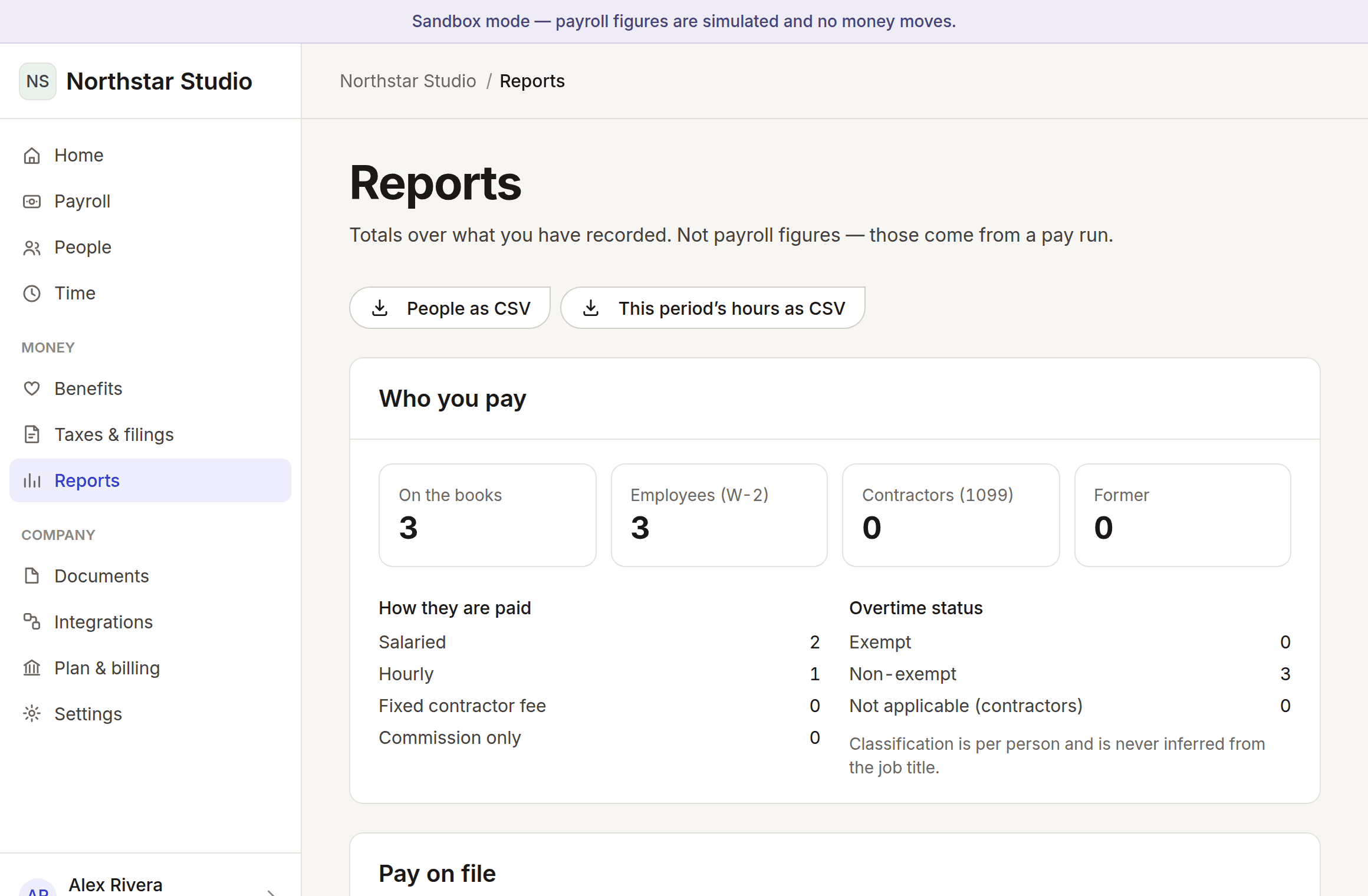
Reports add up what you have recorded: who is on the books by every split that changes what is owed, what the pay on file amounts to, and how many hours were recorded against a period versus how many were approved. That last gap is the work left before a period can run.
Every figure is arithmetic over rows you entered — none of it is a payroll or tax calculation, because those come from a run. Where an assumption is needed to produce a total, the assumption is printed beside the total rather than buried: hourly people are annualised at their standard hours, and anybody on a fee per invoice is left out of the total entirely rather than guessed at.
Exporting is a separate permission from viewing, because putting numbers on a screen and taking them out of the building are different things. Pay columns are withheld from the file when the person could not see them on the page.
In the product: Your company → Reports and Integrations
What it looks like
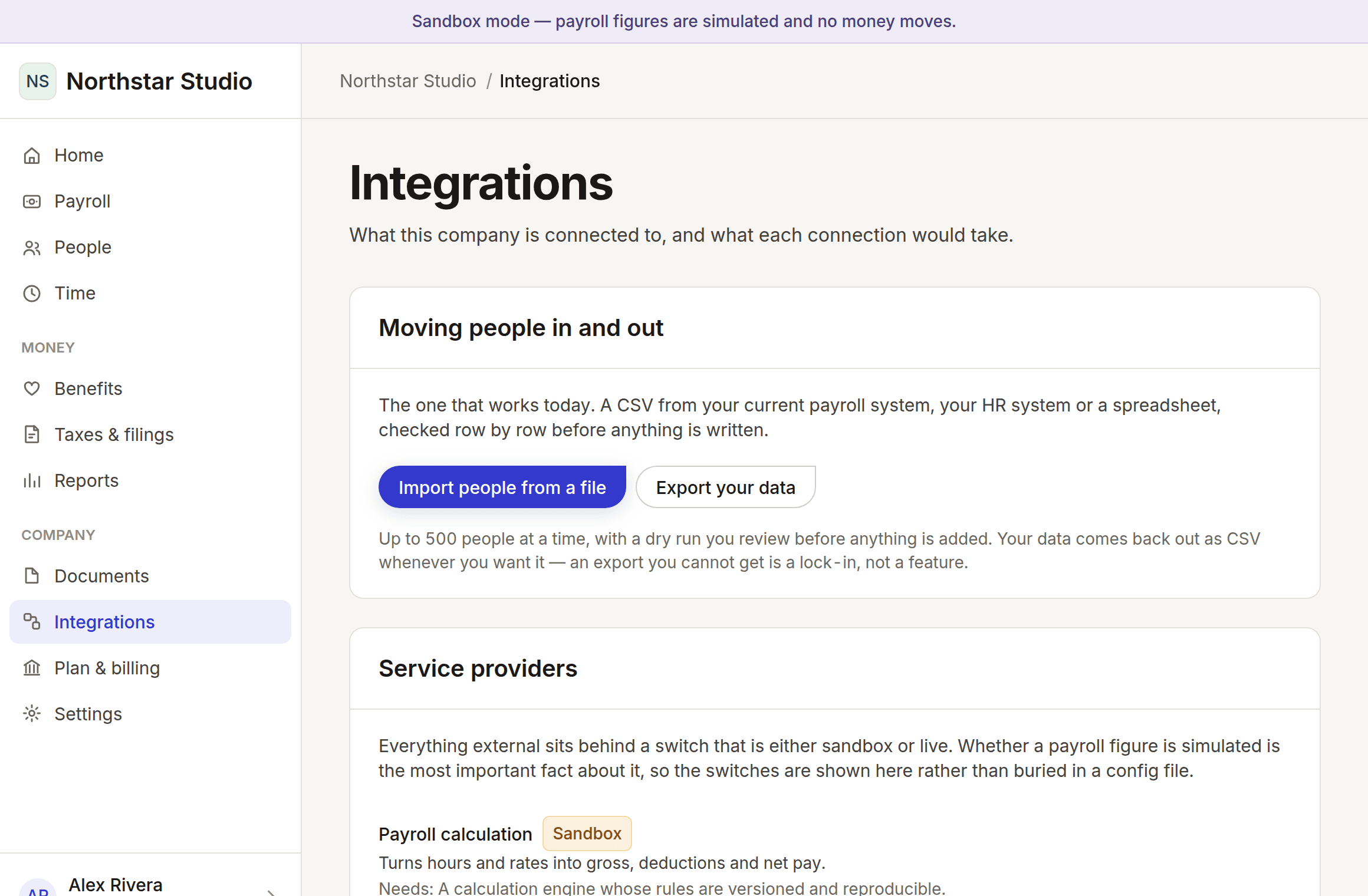
Photographed from the running application, not drawn. Every name and figure in them is invented.
What works today
- Headcount by worker type, pay type and overtime classification
- Total pay on file, with the annualisation assumption stated
- Hours recorded against hours approved, per person and in total
- CSV export of people and of hours, behind its own permission
- Importing people from a CSV, with a dry run
What does not, and why
Posting payroll journals to your accounting system
A real pay run to post.
Directory sync from Entra ID or Google Workspace
SCIM provisioning, and a deliberate rule for what a deactivation means for pay — a sync that can create a worker can also deactivate one.
An API
Not started. The CSV export and import cover the same ground for now, less conveniently and with a person in the loop.
Every line in this area
The same catalogue the pricing table is built from, filtered to this area. One list, one set of markers, everywhere.
- Works today
Reports on your team, pay and hours, as CSV
Headcount by every split that changes what is owed, what the pay on file adds up to, and hours recorded against hours approved. Exporting is its own permission.
- Planned
Payroll registers and agency reports, as PDF
Registers, contributions, agency payments, bank transactions and year-to-date figures — all of which come out of a completed pay run.
- Planned
Accounting export
Journals that match your chart of accounts, out of a ledger that already balances.
- Planned
Integrations with what you already use
Accounting, time, and the tools your team is already in.
- Planned
Open API and webhooks
Every integration we build is built on the same public API you get. If we have not connected the tool you use, you are not stuck waiting for us to.
Read the markers, not the length of the list
Anything marked planned or being built is not working today and is not charged for. Moving money needs a licensed partner and filing needs a status granted by each tax authority — neither is a matter of writing more code, and neither is claimed here.