
Running payroll
Partly workingSee every number, and what changed since last time, before anything is sent.
Where does every number on this payroll come from?
A pay run shows you what the period would pay before anything is committed, and every line says how it was reached. Gross pay is arithmetic over your own hours and rates — hours by rate, or an annual salary divided across the periods in a year — and the page states which of the two produced each figure.
Somebody who cannot be paid correctly stops the run rather than being paid nothing. An hourly worker whose timesheet is not approved is the commonest reason a payroll goes out wrong, and a valid-looking payslip for zero is how it happens: nothing looks broken until payday, when it is found by the person who was not paid.
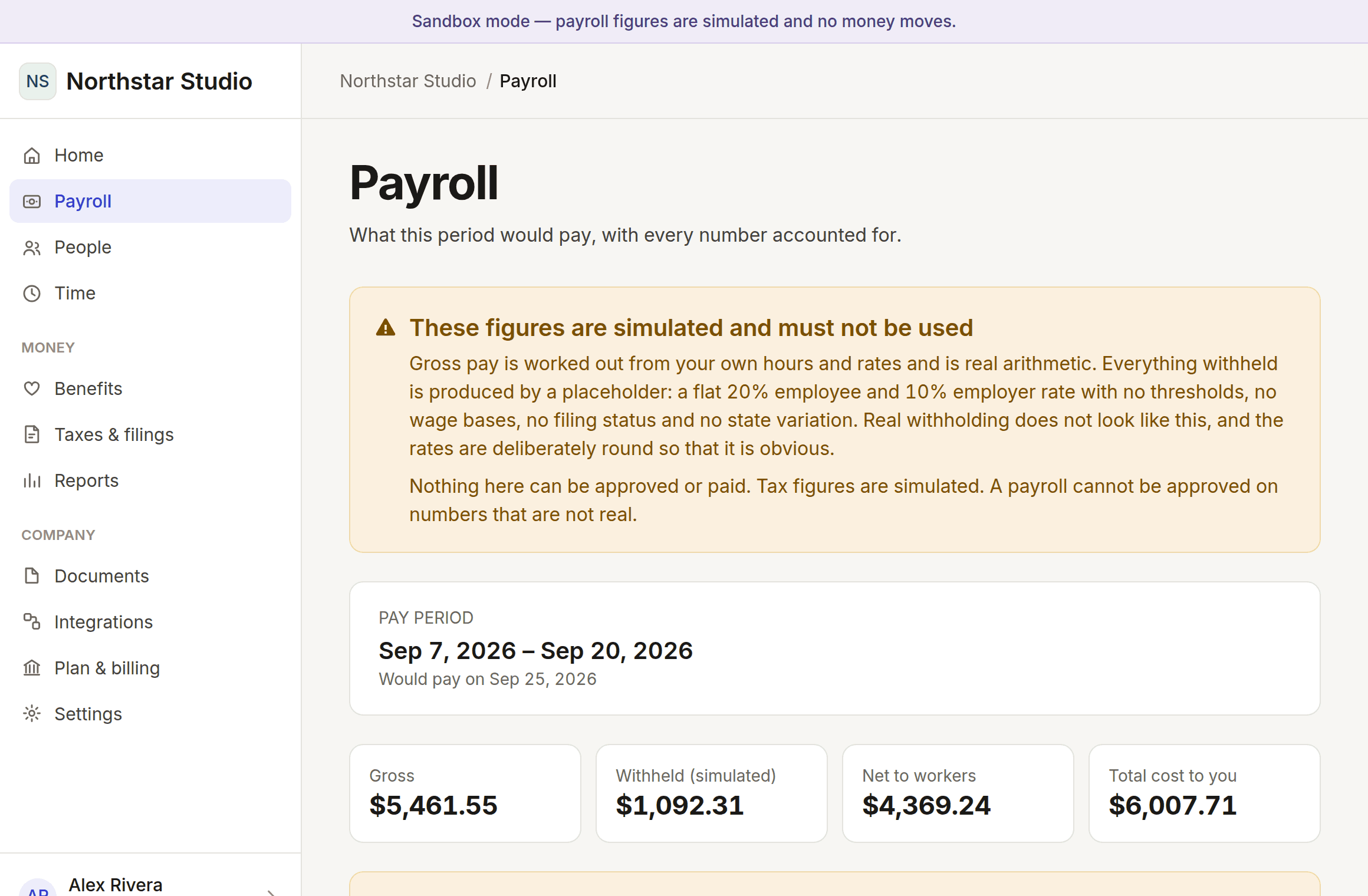
What is withheld does not come from us, and today it does not come from anywhere real. The figures on this page are produced by a placeholder at a flat rate, and the page says so in the largest terms it has. A payroll cannot be approved while that is true — not discouraged, refused, in the code rather than in the interface.
In the product: Your company → Payroll
What it looks like
Photographed from the running application, not drawn. Every name and figure in them is invented.
What works today
- Gross pay from approved hours and from salary, with the method shown per person
- A preview of the whole period before anything is written
- Anyone who cannot be paid correctly blocking the run, with the reason
- Saving a draft run as a record of what the figures were that day
What does not, and why
Real tax withholding
A contract with a tax-data provider. Today a flat placeholder rate stands in, and it is labelled on every screen that shows it.
Approving and sending a payroll
Real withholding first, then a money-movement partner. Approval is refused while either is simulated.
Off-cycle runs, corrections and voids
A first real run to correct.
Every line in this area
The same catalogue the pricing table is built from, filtered to this area. One list, one set of markers, everywhere.
- Works today
Weekly, fortnightly, twice-monthly or monthly pay
Pick the first period and the first pay day; every date after it is worked out for you, including the deadline to approve by.
- Works today
The deadline, not just the pay day
Money takes business days to move, so every pay date carries the date you have to approve by, worked backwards through weekends and non-banking days.
- Works today
More than one pay schedule
Salaried staff monthly and hourly staff fortnightly, in the same company.
- Being built
Run payroll
Every figure opens into the arithmetic behind it, and nothing is submitted until you approve exactly what you were shown.
- Planned
Run payroll from your phone
The whole run — review, the arithmetic behind each number, and the approval — on a phone, with the same password re-entry as anywhere else.
- Planned
Off-cycle and correction runs
A bonus, a correction or a final pay outside the normal schedule.
- Planned
Deadline reminders, automatically
A nudge before an approval deadline, and a nudge to your team before an enrolment window closes, so nobody has to chase anybody.
Read the markers, not the length of the list
Anything marked planned or being built is not working today and is not charged for. Moving money needs a licensed partner and filing needs a status granted by each tax authority — neither is a matter of writing more code, and neither is claimed here.